

Online Master of Science in Computer Science Program
TELL US ABOUT YOURSELF.
Online Master of Science in Computer Science Program
YOU’RE ALMOST DONE!
By submitting this form, you agree to be contacted by Tulane University and its partners via email, phone, or text for program information and application guidance. You grant us permission to call or text you at this number, and that contact may be made using automated dialing systems and/or an artificial or prerecorded voice.
How long does it take to complete the Online Master of Science in Computer Science?

100% Online

10 Courses

Six Focus Areas To Choose From

No GRE Required

20-36 Months To Complete*
*Varies based on class availability and the number of credit hours taken per semester.
$2,128 per Credit Hour**
Understand tuition and financial aid
*Based on 2025-2026 tuition rate. Tuition and fees subject to change each year as approved by Tulane University
How long does it take to complete the Online Master of Science in Computer Science?
The time it takes to earn your MSCS online from Tulane depends on your program pace and individual priorities. You have the option to complete the 10-course, 30-credit hour MSCS at a full- or part-time pace. A full-time pace requires taking two to three courses per semester for five semesters. In this case, you can complete your degree in an average of 20–28 months.
Alternatively, a part-time pace is a manageable workload if you plan to continue working while earning your degree. A recommended part-time pace is one to two courses per semester, which would allow you to complete your degree in approximately 28–36 months. For full- and part-time learners, your weekly time commitment consists of live classes, independent coursework, and study time.

Is this program the right fit for you?
At Tulane, our online master’s in computer science program offers you the option to customize your coursework and areas of emphasis. So whether you’re a seasoned computer scientist or an aspiring artificial intelligence specialist, our degree has something for you.
Prepare for your professional pivot
For technical professionals interested in changing industries, the online master’s in computer science can equip you with the tools to pivot. If you have a STEM bachelor’s degree and are curious about computer science, our Online MSCS program will prepare you with the depth of technical know-how and industry connections you need to succeed in your next role.
Advance in your industry
Today, an Online MS in Computer Science degree is a typical requirement for computer research scientist roles.* If you’re already in the field and eager to advance, our online computer science master’s can help you reach your goals. Develop next-level computing skills, with the option to focus your studies on natural language processing, machine learning, algorithms, and more. Review our career outlook page for a more comprehensive look at the career paths available to you upon graduation.
*U.S. Bureau of Labor Statistics, 2022
Find your specialty
Sights set on a career in research or academia? The computer science master’s degree faculty will help you prepare for your dream job. Our graduate degree also offers you the option to dive deeper into areas like computational geometry, cloud computing, data science, and beyond so that you can become a best-in-class specialist upon graduation.
Online Program Experience
Tulane’s Online Master of Science in Computer Science program redefines flexibility. Here, it means you can complete your online master’s in computer science from wherever you are, at your own pace, all while choosing electives connected to your interest areas.
You are at the center of our Online MS in Computer Science program. As an online student, you will participate in virtual classes with professors and peers while you complete self-paced, project-based assignments on your own schedule. Our small class sizes mean you’ll work closely with your faculty and classmates throughout the program. You can ask questions, share insights, and receive feedback, just like you would taking classes on campus. There are also live office hours to further your connection to faculty and support your mastery of program concepts.
The typical weekly time commitment for the Online MSCS varies based on the number of credit hours taken each semester. On average, you can expect to spend two to three hours per week, per credit hour, on homework and assignments. This includes one 75-minute live session per three-credit-hour course each week.
For more information about the online structure and program experience, schedule time with one of our enrollment advisors today.

Sample Curriculum
What will you learn in a computer science master’s program?
Tulane’s Online MS in Computer Science curriculum challenges you to think beyond basic programming. With an increase in remote work and demand for virtual operational systems, today’s computer science professionals need a wide variety of skills.
Our 30-credit curriculum prepares you with the tools you need to make the most of the expanding digital space while focusing on areas of the field that interest you. Over the course of your degree program, you will complete nine credits of core classes and 21 elective credits based on your chosen focus area.
Focus areas include:
- COMPUTATIONAL GEOMETRY
- COMPUTATIONAL BIOLOGY AND INFORMATICS
- ALGORITHMS AND THEORY
- SYSTEMS
- DATA SCIENCE
- ARTIFICIAL INTELLIGENCE AND MACHINE LEARNING
Please note that Online MSCS courses are subject to change and not every course will be offered every semester.
Bridge Course
Your Title Goes Here
Your content goes here. Edit or remove this text inline or in the module Content settings. You can also style every aspect of this content in the module Design settings and even apply custom CSS to this text in the module Advanced settings.
Students starting in fall or spring term
Students starting in fall or spring terms will take one, 3 credit, non-degree counting course (CMPS 6100).
CMPS 6100 Intro to Computer Science
This class focuses on several core topics in the design, analysis, and implementation of computational tools that are drawn from the fields of data structures, software engineering, and programming languages. Other topics include object-oriented programming, test-driven development, data structures and abstract data types, imperative programming and memory management, and functional programming.
By solving practical, real-life problems in different programming languages and in different ways, students learn to select a language and approach most appropriate for the situation, and prepare to learn new languages independently. The high-level goal of this course is to train students to be able to draw from a versatile set of skills, which in turn will provide a strong foundation for further study in computer science.
Students starting in summer term
Students starting in summer terms will take two, 3 credit, non-degree counting courses.
This course is one of a pair of courses that together establish the foundations necessary for computer science graduate study. These courses do not assume a background in computer science. Together they introduce mathematical foundations, programming fundamentals such as modular design, recursion, object-oriented programming, and functional programming, key ideas from algorithms and analysis including algorithm design, computational complexity, and parallelism, fundamental data structures, crucial concepts for operating systems-level programming, and the organization and design of computer networks. Students in this course will establish a broad foundation for future graduate-level study and exploration of computer science. This course and Computer Science Foundations B are intended to be taken concurrently. This course does not count towards the degree requirements for any graduate program in computer science.
Core Courses
Your Title Goes Here
Your content goes here. Edit or remove this text inline or in the module Content settings. You can also style every aspect of this content in the module Design settings and even apply custom CSS to this text in the module Advanced settings.
CMPS 6610 Algorithms
CMPS 6620 Artificial Intelligence
CMPS 6770 Operating Systems
CMPS 6750 Computer Networks
Elective Courses
Your Title Goes Here
Your content goes here. Edit or remove this text inline or in the module Content settings. You can also style every aspect of this content in the module Design settings and even apply custom CSS to this text in the module Advanced settings.
CMPS 6130 Computational Geometry
CMPS 6662 Information Security
This is a hands-on introductory security course for upper-level undergraduate students and graduate students. Students will learn the basics of cryptography and methods for protecting systems from attack. We will cover malicious software and other attacks that occur over the network, as well as the perimeter defenses used to stop these attacks. Students will then learn about program vulnerabilities that lead to most of the security problems in computing today. We will conclude with the other administrative issues that security professionals must consider in their jobs.
CMPS 6180 Game Programming
This course is an introductory course on the fundamentals of 3D game development. We will focus on the Unity game engine and object-oriented programming with C#. Students will learn various topics including vectors and rotations, character animation, artificial intelligence, and Unity tools, such as Cinemachine, Shader Graph, and Timeline.
CMPS 6790 Data Science
This course is designed for both graduate students and advanced undergraduate students interested in understanding of both the fundamental and advanced concepts, techniques, and technologies required for collecting, processing, and deriving insight into data. Data Science is an interdisciplinary set of topics that includes everything you need to create data driven answers and solutions to specific business, scientific, or sociological questions. Topics typically covered include an introduction to one or more data collection and management systems, e.g., SQL, web scraping, and various data repositories; exploratory and statistical data analysis, e.g., bootstrapping, measures of central tendency, hypothesis testing and machine learning techniques including linear regression and clustering; data and information visualization, e.g., plotting and interactive charts using various technologies; and presentation and communication of the results of these analyses. Students should be comfortable programming in Python and familiar with the fundamentals of algorithmic analysis and computer systems.
CMPS 6350 Introduction to Computer Graphics
A comprehensive introduction to the mathematics and algorithms that drive today’s digital special effects, animation, and games. Designed as a hands-on course, students will gain experience in building 2D/3D interactive applications using OpenGL. Topics covered will include geometric transformations, projections, raster algorithms, 3D object models (surface and volume), visible surface algorithms, texture mapping, lighting/shading, ray-tracing, anti-aliasing, and compositing.
CMPS 6730 Natural Language Processing
This course investigates computational methods to work with human language, analyzing its lexical, syntactic, and semantic aspects. Examples include document classification and clustering, syntactic parsing, information extraction, speech recognition, and machine translation. Theoretical and practical aspects of the latest techniques will be covered, including probabilistic modeling, neural networks, and deep learning.
CMPS 6510 Computer Organization
Structure and organization of computer systems; instruction sets; arithmetic; data path and control design; memory hierarchy.
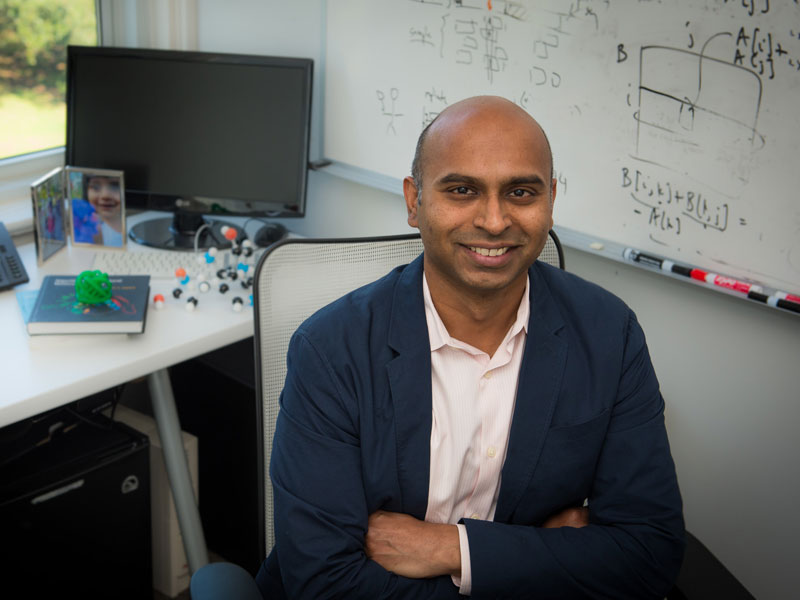


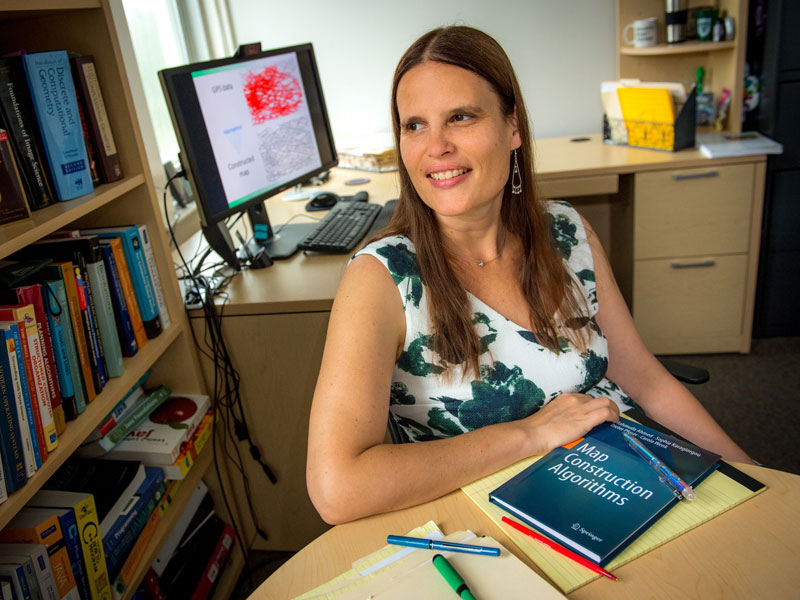
Faculty Spotlight
Meet some of the brilliant minds behind our Online MS in Computer Science at Tulane. Internationally recognized researchers and practitioners, the MSCS faculty bring a high caliber of computer science proficiency to the classroom.
We’re Creating the Future of Computer Science
Tulane professor hopes to demystify artificial intelligence
Tulane professor part of $15 million institute to establish field of imageomics
Tulane awarded $3.67 million grant for quantum computing
Tulane professor wins Early Career Award to tame massive supercomputer datasets
Key Dates
Our cohorts begin in fall, spring, and summer semesters.

Key Dates
Our cohorts begin in fall, spring, and summer semesters.
Scheduled Events
Check back soon for more upcoming events.